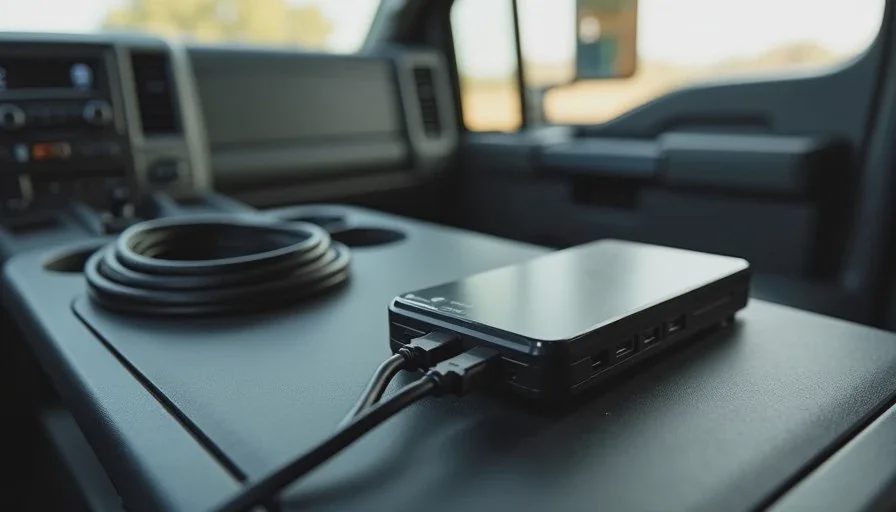
A phone that dies in the middle of a service day creates immediate problems. The next address becomes harder to find. Invoices wait. Customer messages go unanswered. In cold weather or on routes with weak signal the battery drains faster than most people plan for. A backup-power kit that stays in the truck removes a large share of those interruptions. The key is that the kit has to fit in the real space available and still work after months of bouncing around in a vehicle.
I settled on a short list of items after years of appliance repair and field service. The goal was never a complete mobile power station. The goal was enough reserve to finish the day and get home without hunting for an outlet. Everything in the kit had to earn its place by size, durability, and actual usefulness under ordinary working conditions.
Why Truck Power Needs Are Different
Office charging assumptions do not transfer to a work truck. The vehicle may sit for hours in heat or cold. Cables get pinched in doors or buried under tools. Power banks that look compact on a desk can be awkward to store when every console and door pocket already holds something. A kit designed for travel or camping often includes capacity that is never used and bulk that is always in the way.
Field conditions also change the demand. Continuous GPS, repeated camera use, weak-signal searching, and cold temperatures all increase drain. A phone that easily lasts an office day can need a mid-afternoon top-up on a full service route. The backup system has to be ready for that pattern without requiring a special stop.
Space Is the First Constraint
Most work trucks have limited clean storage. The center console, door pockets, a small under-seat area, or a dedicated pouch are the realistic options. Anything that needs its own large case or that cannot tolerate dust and temperature swings becomes a liability. The useful kit stays small enough to live in one of those existing spaces and still be reachable with one hand.
The Core Items That Have Proven Reliable
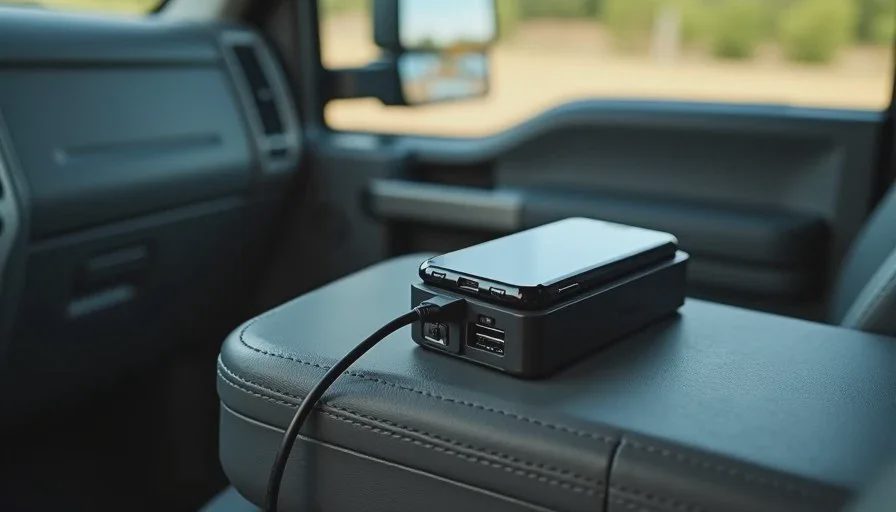
The foundation is a single high-quality power bank with enough capacity for at least one full phone charge and preferably two. Capacity in the 10,000 to 20,000 mAh range covers most field days without becoming bulky. Higher capacity is available, but the extra size and weight rarely justify themselves for phone and small-device use.
The power bank needs at least one USB-C port that supports reasonable input and output speeds so it can be recharged overnight and can top up a phone without excessive waiting. A second port is convenient when a second device needs power at the same time. Build quality matters more than peak specifications. A unit that survives repeated drops onto a truck floor and temperature swings is more valuable than one with impressive numbers that fails after a few months.
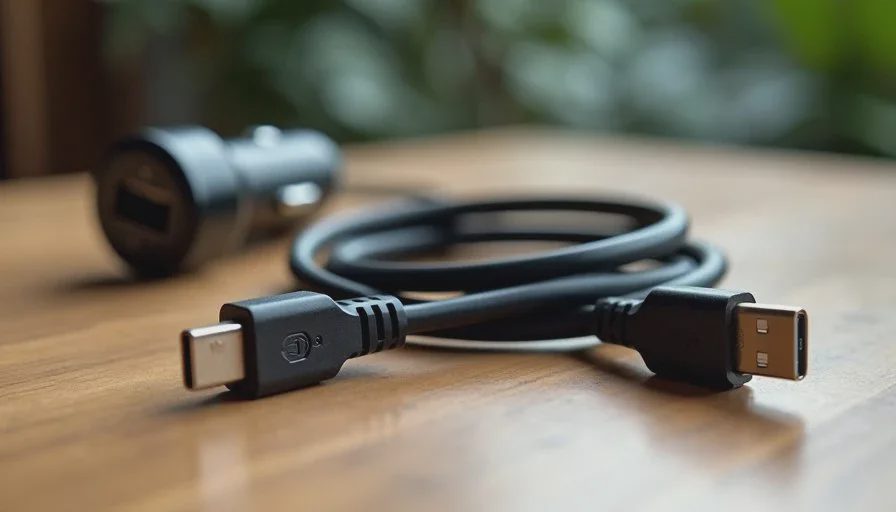
A short, durable USB-C cable and a short USB-A to USB-C cable cover the majority of current phones and accessories. Long cables tangle and take space. Very short cables limit positioning. A length that reaches from a console-mounted bank to the phone in a cup holder or mount is usually enough. Keeping the cables coiled with a simple tie or in a small pouch prevents them from becoming permanent residents of the floorboard.
A 12-volt USB charger that plugs into the truck’s power outlet provides a second path. When the vehicle is running, this charger can feed the phone directly or recharge the power bank. Choosing a unit with decent output and solid construction avoids the common failure of cheap adapters that loosen or quit after repeated use.
Optional Additions That Still Fit
A second, smaller power bank can serve as a pure emergency reserve or as a dedicated unit for a second device. Some technicians keep a short lightning cable or an older standard if they still support mixed devices. A simple mesh pouch or small hard case that holds the bank and cables together keeps the kit from scattering across the cab.
I avoid large power stations, folding solar panels, and multi-device hubs for everyday truck use. They solve problems that rarely appear on a standard service day and consume space that is better left open for tools and parts.
Where and How the Kit Lives in the Truck
Placement determines whether the kit is actually used. A power bank buried under tools or locked in a toolbox might as well not exist when the phone hits 15 percent between jobs. The center console, a dedicated door pocket, or a shallow under-seat tray works if the bank and cables can be reached without unloading other gear.
Temperature affects performance. Extreme heat and cold reduce both the power bank’s ability to deliver energy and the phone’s ability to accept it. Keeping the bank inside the cab rather than in an unconditioned toolbox or truck bed helps. In very cold weather, storing it closer to the interior or even in an inside jacket pocket during long outdoor stretches improves results.
Recharging the power bank is part of the daily or every-other-day routine. Plugging it into the truck charger while driving between jobs or connecting it to a wall outlet at the end of the day keeps it ready. A bank that is repeatedly left empty eventually fails the moment it is needed.
Daily Habits That Make the Kit Effective
The equipment only helps if a few light habits support it. Check the power bank charge level at the start of the week. Confirm the cables are present and undamaged. When the phone reaches roughly 30 percent on a long day, use the bank proactively rather than waiting for a critical warning. In cold weather, begin the top-up earlier because usable capacity drops.
After the day ends, return the bank and cables to their storage spot. A kit that migrates to a jacket pocket or a tool bag tends to be missing the next morning. Consistency matters more than perfection.
What the Kit Is Not Intended to Do
This setup is not designed to run larger tools, inverters, or multiple laptops. It is sized for phones, occasional tablets, and small accessories that appear in ordinary field service. Expanding beyond that role quickly increases bulk and complexity. Separate solutions exist for higher power needs; they simply do not belong in the everyday phone-support kit.
The kit also does not replace basic battery awareness. Offline maps, reduced screen brightness, and limiting unnecessary background activity still matter. Backup power extends the usable day. It does not eliminate the need for ordinary conservation.
Adjusting for Different Routes and Seasons
Rural routes with long gaps between stops and weak signal benefit from the higher end of the capacity range and earlier top-ups. Dense urban routes with more frequent short drives may need less reserve but still benefit from the truck charger for continuous top-ups while moving.
Winter conditions justify more attention to temperature management and earlier use of the bank. Summer heat calls for keeping the bank out of direct sun and confirming that cables have not degraded. The core items stay the same; only the timing and storage habits shift.
Results After the Kit Becomes Routine
Once the backup-power kit lives in a fixed place and is kept charged, the number of mid-day battery crises drops. Invoices go out on time. Navigation remains available. The phone stays a tool instead of a liability. The space cost is minimal. The reliability gain appears on the ordinary long days when coverage is spotty and the schedule is full.
A phone should help you make one less trip, miss one fewer job, and have one fewer argument. A compact backup-power kit that actually fits in the truck supports all three by keeping the device available through the conditions that field work actually produces. Choose durable, appropriately sized pieces. Store them where they can be reached. Keep them charged. The rest of the day becomes easier to finish.



No comments yet — be the first to share a thought.